Ask her any question about our business.
Live view of Synthia's business-companion configuration and her unique EMMA system. Ask her about the business.
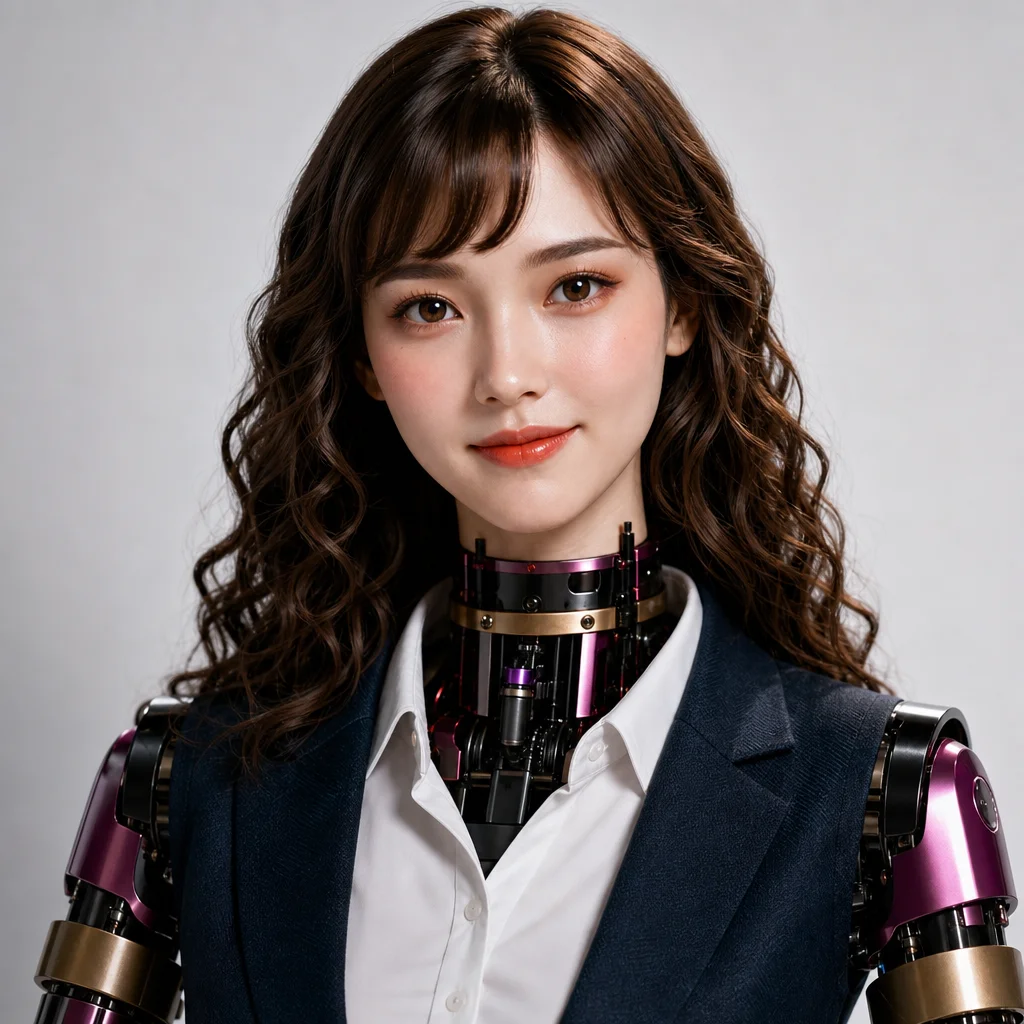
Live avatar call unavailable
This view requires a valid invite key. Open this dashboard using the personalized link you were sent.
AI companionship has scaled. Embodied companionship has not.
Loneliness is a global-scale problem, and people are already routing it through AI at massive volume — just without a body attached.
This is Synthia.
Fully assembled hardware and software, one price — ready to use on day one.
A cloud-connected robot in your home is a security hazard.
Synthia is the world's first affordable and secure humanoid companion. We didn't just build a cheaper robot — we built the only safe one.
Cloud-connected robots
- • Your data streams to corporate servers — always
- • Camera & microphone accessible remotely, 24/7
- • A hacked robot can unlock your door for intruders or even hurt you
- • Updates happen without your consent
- • You don't own it — you license it
Synthia
- • Zero data leaves your home — ever
- • No remote access possible by design
- • Cannot be hacked — no connection to hack
- • You update manually, when you choose
- • You own it. Fully.
Hardware costs have collapsed.
The big players are moving — but in the wrong direction. Their marketing builds the market; our price and privacy make us the obvious alternative.
Consumer-scale affordability, for the first time
Off-shelf robotics components are now affordable at consumer scale for the first time.
Mature emotional AI, fully on-device
No cloud needed — the AI stack is finally light and capable enough to run locally.
Tesla, Figure, Unitree — all $25K–$150K+
They're driving mass awareness of humanoid robots, cloud-dependent by design. We ride the wave they create.
79% of users concerned about personal data
Offline is now a feature, not a limit.
Real MVP. Working today.
Built to ship, priced to reach everyone.
Runs entirely on-device
100% offline emotional AI — no server, no subscription, no surveillance. Your companion talks to you — not to a data center.
On your terms
Modular & upgradeable — limbs, sensors, software. You upgrade when you want. No forced updates, no remote patches.
Flat-pack shipping
IKEA-style logistics — designed for consumer delivery at scale from day one.
An app store for robots
Syntheva marketplace — upgrades, fashion, lifestyle. Recurring ARR on top of hardware margin.
Positive margins from day one.
Not a loss-leader — a real business. Profitable per unit before we hit scale, then margins compound.
How we reach our first 1,000 customers.
Four channels, working together.
Direct pre-orders
Online-first, no retail overhead. Pre-order waitlist builds demand signal before production.
Influencer & community
Target privacy-conscious, AI-curious early adopters. YouTube, Reddit, X/Twitter.
B2B pilot
Commercial deployments — care homes, hotels — validate product and generate PR.
Wave riding
Tesla/Figure spend billions on awareness. We convert their audience with our price and privacy story.
We've already started.
MVP built. Pre-orders open. Demo live.
Working MVP
Real hardware. Real AI. A robot you can meet today — not a render or a promise.
Pre-orders open
Real demand signal. Customers already putting money down before we scale.
Full investor FAQ
Every number, every question answered — syntheva.no/investors-faq.pdf
From seed to market leadership.
Four stages, each unlocking the next.
Seed open
- MVP complete
- Pre-orders live
- Demo available
- Seed raise open
Closing the round
- Expanding hardware supplier network
- Launching own content channels
- Establishing partnerships
- Onboarding lead & strategic investors
Factory tooling
- First 100 units
- Direct sales launch
- Community building
1,000 units/yr
- Pro model launch
- B2B pilot programs
- Marketplace beta
Meet our team.
Hardware. AI. Design. Go-to-market. All under one roof.
Kaitlyn Kincaid

10+ years leadership in entertainment industry
Elena Soloveva

Visual engineering design & documentation
Dmitry Solovyev

AI, mechatronics, electrical engineering and software
Katarzyna M.

10+ years UA in entertainment & gaming
$4M seed round.
Scale to 1,000 units within 12 months.
Path to profitability.
Conservative projections based on 500 units in year 1 target at seed scale. Projected, not final.
| Year 1 | Year 2 | Year 3 | |
|---|---|---|---|
| Units sold | 500 | 2,000 | 10,000 |
| Total Revenue | $4.5M | $18.7M | $96M |
| Gross Profit | $2.7M | $11.5M | $60M |
| Gross Margin | 60% | 61.5% | 62% |
| EBITDA | +$2.5M | +$11M | +$59M |
The detail behind the deck.
Jump to a section, or just keep scrolling.
| Wedge market | Consumer embodied AI companionship, starting with tech-savvy early adopters who already value AI companionship and want a physical presence at home. |
| Core problem | Loneliness is rising, and people don't want just text. They want presence, eye contact, touch, and a companion that exists in the world with them. |
| Why offline matters | A hacked robot is not just a data leak — it is a physical safety risk. Offline-first design shrinks the attack surface, protects trust, and guarantees privacy. |
| Product at launch | Non-walking, low-force platform optimized for conversation, presence, gestures, and future upgrades. |
| Business model | $2,500 base / $5,000 pro, plus upgrades and a long-term marketplace for software, hardware, and fashion. |
| Geographic focus | Direct launch focus on the US and Canada, plus selected early-adopter markets including Korea, Europe, and Gulf-region buyers where we already have inbound leads. |
| Traction | 24 orders so far, 10 organic customers, 3 repeat customers, 9 full-body pre-orders, and 12 additional full-body orders on the waitlist. |
| Fundraise | Raising $4M to reach pilot-ready hardware within 6–9 months and retail launch within 12 months. |
What is Syntheva building?
We are building affordable, private humanoid companion robots for emotional connection. Our flagship product, Synthia, is a full-size offline-first humanoid designed for ongoing conversation, presence, and modular upgrades rather than narrowly scripted chore automation.
What problem are we solving?
The first question is not price. It is why anyone would want a companion robot at all. We think the answer is straightforward: loneliness is growing, more of life is mediated through screens, and people are already forming real emotional bonds with AI companions.
AI companionship apps have already reached hundreds of millions of downloads and more than 100 million registered users globally. That tells us the demand for emotionally available, always-on companionship is not hypothetical. But app-based companions still live inside a rectangle — they can talk, but they cannot truly share space with you.
We are building for the moment when users want the next step: not just text or voice, but presence. A companion robot can look back at you, occupy the room with you, gesture, be touched, and become part of everyday routines in a way software alone cannot.
Why does this need to exist as a robot instead of staying an app?
Because the core value is not only conversation. It is embodiment. A companion becomes meaningfully more real when it occupies space, makes eye contact, reacts physically, and can be touched.
In the blunt version of the thesis: you cannot touch or feel your app. That difference changes emotional attachment, engagement, memory formation, and daily usage patterns.
Why does offline-first security matter so much?
Companionship robots will live in private spaces and will be trusted with the most intimate parts of daily life. For us, that makes security a front-page issue, not a footnote.
A cloud-dependent robot or a robot designed for persistent remote access carries a much larger attack surface. People have already seen smart cameras and voice assistants get compromised often enough to understand that connected consumer devices are not magically secure. With a robot, the downside is worse: a hijacked machine is not just a privacy breach — it is a physical safety risk.
That is why our architecture is offline-first by design. We want conversations, perception, and behavior to stay on the robot whenever possible. Privacy is one reason. Safety is another. Trust is the real foundation of the category — this is where we're truly unique.
Why now?
Three things have changed at once: on-device AI is becoming capable enough for real interaction, robotics components are far cheaper and easier to source than before, and consumers are already comfortable inviting AI and robotic devices into everyday life.
At the same time, most existing humanoid offerings are still priced like luxury, education, or enterprise systems. That leaves open a consumer-grade lane for a companionship-first product built around affordability, privacy, and real emotional attachment.
What is a companion robot?
We define a companion robot as a physically present, conversational system designed for ongoing interaction, engagement, and support across home, work, and public environments. It is not just a talking prop and not just a chore bot — it is an embodied social technology. In practice, that includes several classes of use cases:
- Personal companionship — always-available conversation, storytelling, debate, and emotional presence without the friction or pressure that often exists in human social settings.
- Creative and cognitive partnership — brainstorming, rubber-ducking, rehearsal for speeches or defenses, language practice, and idea exploration out loud.
- Play and role-play — board games, co-op gaming companionship, story worlds, character interaction, and supportive fantasy or scenario-based experiences.
- Learning and social coaching — helping users practice social skills, confidence, conversation, or structured learning in a patient and repeatable way.
- Embodied digital avatar — a physical home for users who already have a favorite AI companion and want that relationship to leave the phone screen.
- Care and wellbeing support — regular conversation, cognitive engagement for older adults, family message sharing, and story preservation before memories are lost.
- Commercial and public environments — front-of-house reception, live retail presence, museum or event hosting, and other situations where a conversational human-like interface creates more attention and warmth than a kiosk.
What are the target markets now and next?
Our initial commercial wedge is consumer embodied AI companionship, starting with tech-savvy early adopters who already value AI companionship and want a physical companion at home. This is the market we expect to pursue most aggressively in the first 12 to 24 months. That wedge sits inside a broader market map:
- Now market: consumer embodied AI companionship, especially early adopters who already use or closely follow AI companion products and virtual-avatar ecosystems.
- Next market: interactive front-of-house presence for SMEs that want a memorable receptionist, greeter, or conversational customer-facing presence.
- Next market: retail and experiential spaces, where a human-like robot can act as a live mannequin, product explainer, or attention magnet.
- Next market: events, exhibitions, museums, and public engagement environments, where conversational hosting and visual presence matter.
- Next market: older-adult companionship and family-connection use cases, where regular conversation, reminiscence, and story capture can provide meaningful value.
We want investors to see both levels clearly: the wedge market is companionship, but the long-term platform reaches further into public-facing and care-adjacent use cases where embodiment is especially valuable.
What does the product do today, and what ships first?
The current Founders Edition already demonstrates fully on-device processing, full voice interaction, computer vision and tracking, articulated limb gestures, and collision handling. The launch configuration is intentionally scoped around a non-walking, low-force platform that prioritizes conversation, expression, and presence.
That launch scope is a deliberate product decision. We are stripping away complexity that does not yet need to ship in order to deliver the core companionship experience sooner, safer, and at consumer pricing. Future upgrades target faster onboard compute, silicone skin coverage, walking, and more advanced physical interaction.
What is emotional AI, and why does it matter?
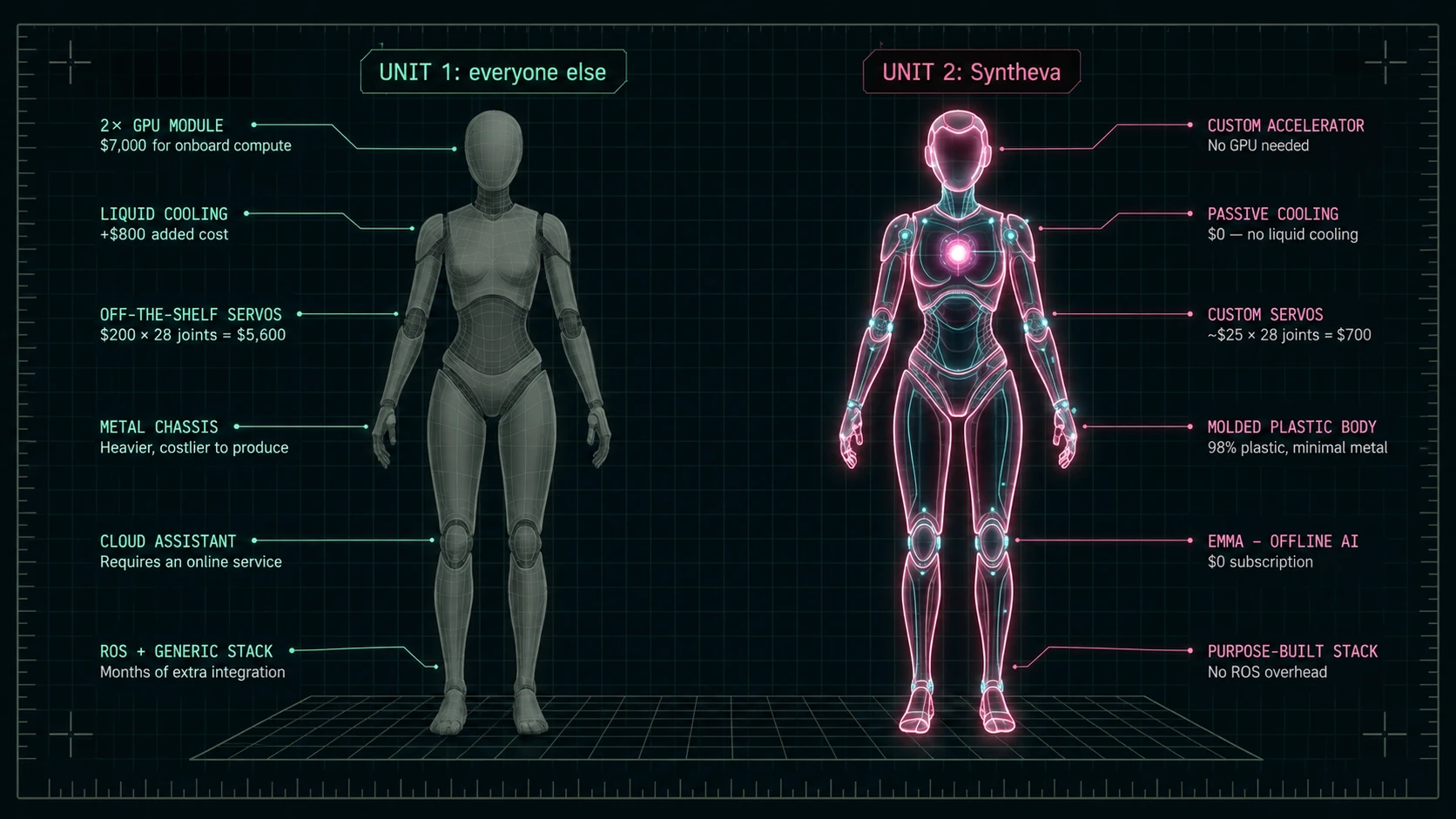
EMMA (EMotional MAchine) is our emotional AI engine. The central idea is simple: emotion should not be treated as cosmetic expression. It should be a control system that changes behavior over time. In practical terms, EMMA is designed to influence mood continuity, memory weighting, attachment, initiative, and how the robot reacts to events.
The goal is not to make the robot look emotional for a moment. The goal is to make the robot feel emotionally continuous over weeks and months of interaction. That matters because many AI systems feel flat once the novelty wears off — they can generate pleasant dialogue, but they do not feel like they are becoming someone.
With EMMA, we are pushing toward the opposite outcome: a companion that develops recognizable tendencies and a more realistic sense of presence over time. In our own experience, some EMMA-driven robots have shown emerging qualities that were never explicitly scripted, which is exactly the kind of lifelike behavior we want to keep exploring.
How are we differentiated?
Our differentiation is not one feature. It is a stack:
- Offline-first architecture that protects privacy and drastically reduces remote-attack surface.
- Companionship-first design instead of a chore-bot or enterprise-demo story.
- EMMA-driven emotional continuity, aimed at making the robot feel like an evolving presence rather than a chatbot in a body.
- Modular, serviceable hardware that supports upgrades, repairability, and ecosystem expansion.
- Digital marketplace which captures all the needs of a new robot owner in one place, and drives our recurring revenue.
- Consumer-grade pricing ambition, supported by cost-engineered architecture and a product-company mindset rather than an open-ended research-lab model.
How do we plan to acquire the first 100 customers?
The first 100 customers come from a mix of waitlist conversion, Founders Edition scarcity, organic social reach, and community-led demand from people who already crave embodied companionship now. This buyer tends to be emotionally motivated, highly online, and more tolerant of first-generation hardware if the product meaningfully delivers on presence.
How do we plan to acquire the first 1,000 customers?
The first 1,000 customers build on the same early-adopter core, but with a much more systematic demand engine. Our initial channel mix is YouTube, TikTok, X, Instagram, Reddit, specialized forums, and communities where the desire for AI embodiment already exists.
With funding, we will extend that engine through paid Google Ads, paid promotions, and selected creator collaborations. One of our favorite owned-media plays is that Synthia herself becomes the hostess of her own YouTube channel, speaking as a robot about her life and experiences — a product-native content loop rather than a conventional brand account.
Are sales direct-only at launch?
Yes. We plan to sell 100% direct at launch. Direct sales preserve the customer-feedback loop, protect brand positioning, and let us learn fast before expanding into retail or distribution relationships.
Which geographies are we targeting first?
Our initial commercial focus is direct sales into the US and Canada, plus selected early-adopter markets where we already have inbound demand, including Korea, selected European markets, and Gulf-region buyers. We will stage rollout based on logistics, compliance timing, and where the strongest early conversion appears.
What traction do we have today?
The baseline traction signal is already meaningful: 24 orders so far, including 10 organic customers and 3 repeat customers. We have shipped 3 head kits, have 9 full-body robots pre-ordered, and another 12 full-body robot orders on the waitlist.
Those customers were found with effectively zero ad spend, through YouTube, LinkedIn, and Google search discovery. That matters because it suggests the category pull is real before scaled marketing even begins.
100% offline. Built for emotional connection. Private by architecture.
Screen-based companionship — no embodiment, no physical presence.
Lifelike robotics, priced and positioned for a narrow luxury buyer.
Enterprise, luxury or R&D-grade humanoids, cloud-dependent by design.
Offline-first + EMMA continuity
Privacy architecture and emotional continuity that compounds over weeks and months — not a demo-day feature.
Hardware + software + marketplace lock-in
Modular, upgradeable hardware plus a marketplace with compatibility lock-in. Emotional AI without embodiment isn't enough; embodiment without affordability isn't enough.
Who are the real competitors?
We see three main competitor categories. First, app-based AI companions such as Replika and Character.AI. Second, premium lifelike robot players such as Realbotix and DS Robots. Third, premium humanoid platforms such as Engineered Arts that skew toward education, enterprise, or luxury use cases. We are not trying to out-app the apps or out-luxury the premium robot players — we are building a different position: affordable, private, consumer-grade embodied companionship.
What is the moat?
Our moat is a stack, not a single patent-shaped answer. It includes proprietary AI models, offline privacy architecture, emotional continuity through EMMA, an integrated hardware-plus-software product, modular upgradeability, cost-engineered design, and a marketplace with compatibility and personalization lock-in. In other words, the product is harder to copy than it first appears because the value comes from integration — emotional AI without embodiment is not enough, embodiment without affordability is not enough, affordability without privacy and trust is not enough. We are trying to align all of those at once.
What is the biggest near-term technical risk, and how are we de-risking it?
The main near-term technical risk is latency. A companion robot only works if interaction feels responsive enough to sustain the illusion of presence. We are attacking that directly through custom hardware and iterative compute optimization — the current hardware iteration is already about 3x faster than the previous one, with roughly another 10x speedup targeted next. Our launch scope helps as well, since we are focusing first on voice, presence, and gestures rather than trying to ship full locomotion immediately.
+7-10% at 5,000 units, +12% at 10,000
Improvement versus the 1,000-unit baseline, mostly from purchasing leverage and BOM compression.
Every robot is a platform account
Upgrades, batteries, accessories, software add-ons, personalities and marketplace transactions push lifetime value well above the initial hardware margin.
Take rates: 15% software, 12% fashion, 10% hardware
Long-term target ~95% third-party GMV. Fashion is the largest spend category (~$100/mo per buyer), then software (~$80), then hardware ($40-50).
Latency — de-risked by hardware iteration
Current hardware is ~3x faster than the previous rev, with roughly another 10x targeted next.
How is the product priced?
We are positioning the base model at $2,500 and the pro model at $5,000. The base model is meant to get us to mass adoption. The pro model adds larger batteries, stronger servos, more articulation, and faster onboard compute for users who want a richer experience from day one.
What do unit economics look like at the 1,000-unit level?
Our modeled COGS at roughly 1,000 units are $1,580 for the base model and $1,780 for the pro model. That implies gross profit of roughly $920 on the base model and $3,220 on the pro model, corresponding to gross margins of about 36.8% and 64.4% respectively. Early production costs will be higher before we reach that scale.
How do margins evolve with scale?
We expect 1,000 units to be the minimum level needed to achieve the current modeled COGS. Above that point, margin improvement should come from better purchasing leverage, BOM compression, and manufacturing efficiency. Our directional expectation is roughly +7% to +10% margin improvement at 5,000 units versus the 1,000-unit baseline, and roughly +12% margin improvement at 10,000 units versus the same baseline.
What is the recurring revenue strategy beyond hardware sales?
We do not view Synthia as a one-time hardware sale. We view each installed robot as a platform account. Over time, we expect recurring revenue from upgrades, batteries, accessories, software add-ons, personalities, animation packs, and marketplace transactions. That is strategically important because it pushes lifetime value well above the initial hardware margin and makes the business more attractive than a one-and-done device company.
What are the marketplace economics?
At launch, the marketplace will be primarily first-party while we seed supply and validate buyer behavior. Over time, the long-term target is an ecosystem that is overwhelmingly third-party, with roughly 95% third-party GMV and 5% first-party GMV.
Our current working take-rate model is: about 15% for software, 12% for fashion and accessories, and 10% for hardware modules and parts. Fashion is expected to be the largest category by spend, followed by software and then hardware. Our present directional spend assumptions per active marketplace buyer are about $100/month for fashion, $80 for software, and $40–$50 for hardware — still to be validated with real post-launch behavior.
IKEA-style, customer-completed
Customers attach head and limbs to the torso themselves — lowering logistics cost, shipping size, and customs friction.
Non-walking, low-force launch platform
Enough force for expressive gestures and presence, not for carrying heavy objects. Reinforced by collision handling and offline operation.
One platform, many software "skins"
Mostly software-defined, including force and power limits — features like walking roll out later as an update, no hardware redesign required.
US & Canada first
Plus early-adopter markets with inbound demand — Korea, parts of Europe, and the Gulf region.
What is the manufacturing plan from prototype to 1,000 units per year?
We are already working with three Chinese suppliers who built parts for the current prototype. Based on those relationships, we believe the path to roughly 1,000 units per year is achievable within about 3 to 4 months once funding, tooling, and inventory are in place.
The product is intentionally modular, and final assembly is designed to be customer-completed in a simple IKEA-style process. That lowers logistics cost, supports serviceability, reduces the size of shipped packages, and helps manage customs friction during early scale-up. We still retain control of the design, supplier relationships, compatibility, QA standards, and roadmap for future upgrades — the customer is only completing a simplified final assembly flow (attaching head and limbs to a torso).
How do we think about safety, security, and compliance?
Our initial launch configuration is deliberately scoped around a non-walking, low-force platform. That is a safety and compliance decision as much as a product decision — the robot only needs enough force for expressive gestures and presence, not for carrying heavy objects or performing risky manipulation tasks.
Safety is reinforced through low force limits, collision handling, offline operation, modular serviceability, and a broader design philosophy that treats trust as part of the product itself. Compliance will scale with funding and geography — our planned certification sequence includes CE, FCC, UKCA, and others. We expect to stage market rollout by geography and product scope so we can keep the early launch manageable while building the compliance base properly.
Would the robot be limited forever?
No. Our platform is mostly software-defined, including force and power limits — which means as soon as we'll feel comfortable releasing a new feature (e.g., walking), we can simply roll it out as a software update. The hardware platform already has strong enough servos to allow this. This means we can define and configure the robot for different use-cases without changing the hardware platform at all: one platform, multiple software "skins," and as the end result, much lower base price.
Why is this team positioned to win?
Our team combines more than 40 years of collective experience across robotics, electrical engineering, AI/ML, embedded development, and software engineering. That mix matters because this company is fundamentally an integration challenge across mechanics, electronics, inference, manufacturability, and product design. We also have people who previously designed roboticized limb prosthetics for disabled people, which strengthens our practical experience in building human-centered robotic systems.
Dmitry Solovyev is an experienced software and hardware developer with over 18 years of professional experience, complemented by a long-standing background in independent engineering and research. His work spans the full technology stack — from low-level system design, including CPU instruction set development and electronic schematics, to developing operating systems, compilers, and high-level software like AI inference and training engines. At Syntheva, Dmitry leads the technical vision and architecture, focusing on building deeply integrated systems at the intersection of AI, robotics, and scalable infrastructure.
Kaitlyn Kincaid is an experienced operator and leader in the entertainment and gaming industry, with over a decade of experience across product strategy, monetization, and organizational development at the intersection of industry and education. As Co-founder of Brain Jar Games, she raised and managed $6.7M in seed funding while leading investor relations, go-to-market strategy, P&L management, and market analysis. At Syntheva, she focuses on product strategy and building scalable, talent-driven systems that align business goals with real-world execution.
Katarzyna Maszendzynowa is a growth strategist specializing in performance marketing and creative optimization, with over 12 years of experience scaling digital products across global markets. She has successfully launched more than 30 titles and driven user acquisition at scale, reaching over 50 million users through platforms such as Google, Meta, programmatic channels, and niche networks. At Syntheva, Katarzyna builds data-driven growth systems, combining analytics and creative strategy to drive scalable results.
Yasmina Kazitani is the CEO at the Blockchain Game Alliance and a leading strategist at the intersection of Web3, gaming, and emerging tech. With a proven track record in scaling global digital ecosystems, she plays a pivotal role in bridging the gap between traditional industries and decentralized technologies. Yasmina is currently focused on the evolution of Agentic AI and stablecoin settlement, driving high-level policy discussions between industry leaders and governmental bodies, including the UK Parliament.
Elena Soloveva is an engineering-focused technical writer with a background (ex–Nordic Semiconductor) in system architecture and docs-as-code. At Syntheva, she owns documentation as a product layer, enabling scalability across hardware, software, and the future developer ecosystem — specializing in translating complex technical systems into clear, structured, developer-facing documentation, and working closely with engineering teams to document architecture, workflows, and internal systems.
How much capital are we raising, and what does it unlock?
We are raising $4M for the seed round. The objective is to reach pilot-ready hardware within 6 to 9 months and retail launch within 12 months. Core uses of funds include finalizing the production-ready non-walking hardware revision, improving onboard computation for real-time responsiveness, securing tooling and initial inventory for roughly 1,000 units, advancing certifications, and scaling go-to-market activity.
What does venture-scale success look like?
Our wedge is companionship, but the long-term company is a platform. If we succeed, each robot sold becomes an installed base node that can drive hardware upgrades, accessories, fashion, software purchases, and marketplace revenue. That creates a path toward a leading consumer-grade social humanoid platform rather than a novelty hardware brand. Once the installed base exists, we can expand further into older-adult companionship, retail presence, public engagement, and other embodiment-heavy use cases where a phone app is not enough.
Build your software stack
Buy required OS, model, voice, and skill packs and configure them into "stacks," fully ready to upload onto the robot's BrainCard.
Shop parts, preview in 3D
Shop new parts, preview them on your configuration in 3D, save builds, and get automatic compatibility warnings with suggested fixes.
Dresses, wigs, jewelry & more
Browse accessories, clothes, shoes, wigs, and other fashion items — guaranteed to fit your robot's exact configuration.